
Redblock Technical Bulletin
Wedi Subliner Dry / Joint Sealant Adhesion Test
At Redblock's request, Wedi performed laboratory tensile-bond/adhesion testing to evaluate Wedi Subliner Dry bonded to the stainless-steel surface of a supplied Redblock shower niche using Wedi Joint Sealant and, alternatively, Wedi 620. This bulletin summarizes the Joint Sealant test evidence, Wedi's recommendation, the tested application conditions, current U.S. product-system context, and the limits of what the test establishes.
The report supports adhesion performance of the tested membrane / sealant / stainless-steel interface; it was not a waterproof-integrity test and does not certify the completed shower assembly.
What Wedi Tested and What It Found
Wedi QA/QC tested five Subliner Dry + Joint Sealant specimens bonded to the Redblock stainless-steel niche surface after a 72-hour cure. All five passed with no recorded failure; the report states that removal could not be achieved at the measuring equipment's maximum pull force.
The testing evaluated adhesion only. It did not evaluate waterproof integrity of the completed niche or shower assembly.
| Testing organization | Wedi QA/QC |
|---|---|
| Report | Product/Process Test Report 2101; source file WUS-TR-V01-2101bl |
| Report date | November 15, 2021 |
| Primary Redblock interface summarized here | Wedi Subliner Dry + Wedi Joint Sealant + Redblock stainless-steel niche surface |
| Joint Sealant specimens | 5 |
| Cure before tensile testing | 72 hours at 73°F and 50% relative humidity |
| Result | 5 of 5 Joint Sealant specimens passed; no failure was recorded |
| Maximum-pull observation | Report states removal with the measuring equipment was not possible because adhesion was not affected at the equipment's maximum pull force |
| Forced-failure observation | After the successful test, forced failure occurred within the Subliner Dry / Joint Sealant materials rather than through reported loss of adhesion from the stainless-steel surface |
| Wedi conclusion | Wedi states that it can safely recommend Wedi Joint Sealant, or alternatively Wedi 620, for adhering Wedi Subliner Dry over the tested stainless-steel niche flange assembly when the specified procedure is followed |
| Test limitation | Adhesion performance only; not a waterproof-integrity test or a general warranty of the complete field installation |
Why the Test Was Performed
The test objective was to determine the bond strength of Wedi Joint Sealant—and, as an alternative, Wedi 620—between Wedi Subliner Dry and the stainless-steel niche surface.
Because the supplied niche did not provide enough test area on the front flange for multiple specimens, Wedi set up the test on the back of the supplied niche. The report explicitly states that the front and back were made from the same material and had the same surface finish.
Five specimens were created for the Joint Sealant / Subliner Dry combination, and five additional specimens were created for the Wedi 620 / Subliner Dry combination. This bulletin focuses on Joint Sealant because the Joint Sealant / Subliner Dry combination is the tested interface referenced in Redblock's shower-niche technical documentation.
Test Preparation and Tensile-Bond Procedure
The specimens were cured for 72 hours under the reported laboratory ambient conditions before tensile testing.
Step 1: Prepare specimens
Wedi Subliner Dry specimens were bonded to the stainless-steel niche surface using Wedi Joint Sealant; a second five-specimen set used Wedi 620.
Step 2: Cure
The report specifies a 72-hour cure at 73°F and 50% relative humidity before the pull-test mounting blocks were attached.
Step 3: Pull test
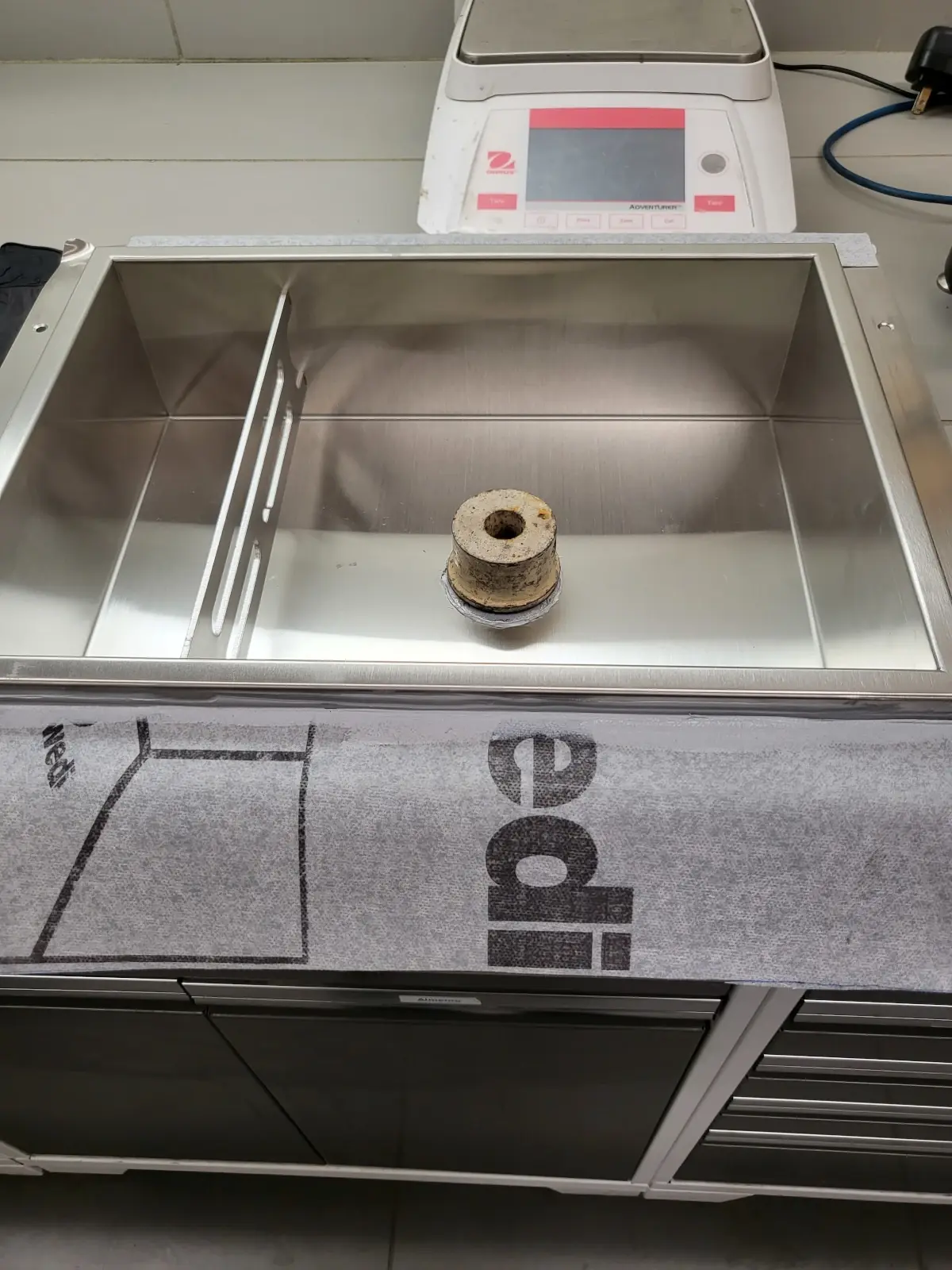
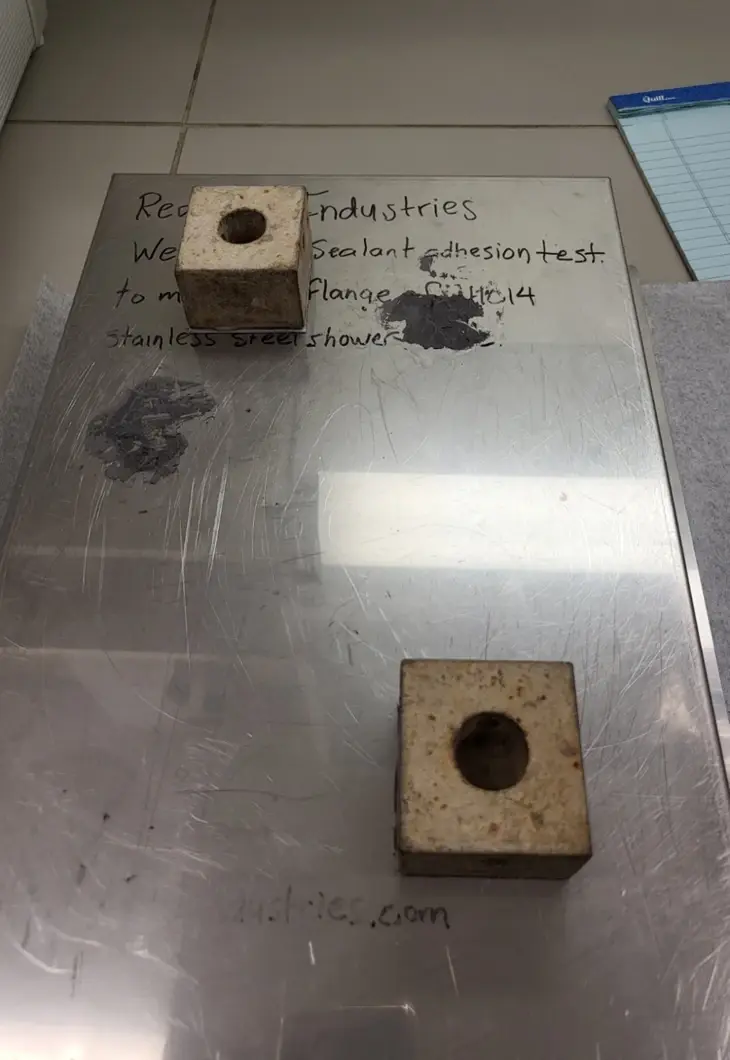
Mounting blocks were attached with high-strength two-component epoxy, the tensile-test device was connected, and the specimens were pulled to evaluate tearing, delamination, deformation, adhesion, and cohesion.
This bulletin does not convert the laboratory equipment limit into a Redblock bond-strength rating or design value. The report's practical finding is used as written: the bonded samples were not removable with the measuring equipment at its maximum pull force.
All Five Joint Sealant Specimens Passed with No Recorded Failure
The Wedi report states that all five specimens in each tested material combination passed the tensile-bond test and that no failure was recorded.
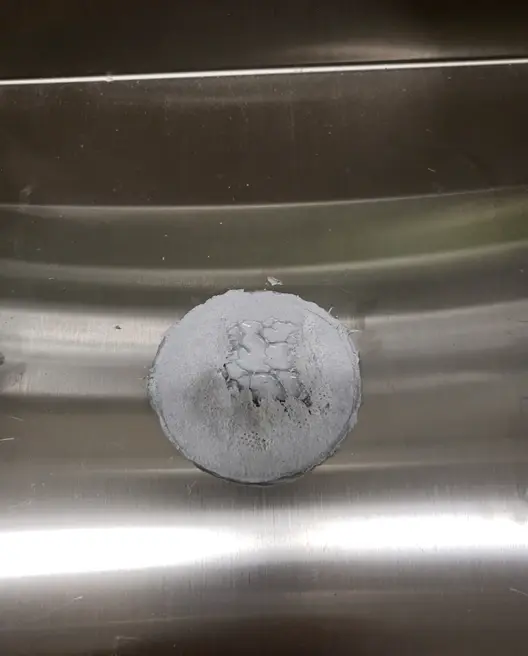
For the Joint Sealant / Subliner Dry combination summarized here, the attached test-photo caption reports that removal with the measuring equipment was not possible because adhesion was not affected at the maximum pull force available to the equipment.
After the successful test, Wedi deliberately attempted a forced failure. The report records that the resulting failure occurred in the cohesion between Subliner Dry and Wedi Joint Sealant and internally within those materials. In other words, the report did not identify loss of adhesion from the tested stainless-steel surface as the forced-failure mode.
Tested Application Conditions for Subliner Dry and Joint Sealant
Based on the adhesion test, Wedi states that Joint Sealant can be safely recommended for adhering Subliner Dry over the tested stainless-steel niche flange when the specified preparation, coverage, embedding, environmental, and cure conditions are followed.
| Surface preparation | Clean the stainless steel and remove oils or grease using denatured alcohol |
|---|---|
| Sealant coverage | Apply Wedi Joint Sealant over the entire attachment surface |
| Minimum sealant thickness | 1/16 in. |
| Suggested spreading tool | 1/8 × 1/8 in. adhesive trowel |
| Membrane embedding | Firmly embed Subliner Dry into the sealant bed with light, equally distributed pressure/weight |
| Initial pressure period | 60 minutes |
| Application temperature | 65–80°F ambient |
| Relative humidity | Not below 50% |
| Cure before tensile/shear force | 72 hours |
The report limits the recommendation to this specific assembly: the tested stainless-steel niche specification with Wedi Subliner Dry and the stated sealant procedure. It should not be generalized to different metals, surface finishes, membranes, adhesives, or installation conditions without separate substantiation.
Test Report 2101 Covers the Subliner Dry / Joint Sealant Interface
Since the 2021 testing was performed, Wedi has informed Redblock that its current U.S. sheet membrane is marketed as Wedi S-DRY and that seams and attachments use Wedi S-DRY SEAL, a two-component acrylic material. Wedi Joint Sealant remains available.
The original test remains valid evidence for the specific Subliner Dry + Joint Sealant interface evaluated in Report 2101. It should not be interpreted as adhesion test evidence for the current Wedi S-DRY + Wedi S-DRY SEAL combination unless that combination is separately tested.
Adhesion Evidence Is Not the Same as Waterproof-Integrity Testing
The report supports
- Adhesion of Subliner Dry to the tested Redblock stainless-steel surface using Wedi Joint Sealant under the reported conditions
- 5 of 5 Joint Sealant specimens passing the tensile-bond/adhesion test with no recorded failure
- Wedi's recommendation of Joint Sealant for this specific tested interface and procedure
The report does not establish
- A waterproof-integrity or hydrostatic-pressure rating for the completed niche installation
- Certification of the entire shower waterproofing assembly
- A general warranty for every field installation or for untested membranes, adhesives, surfaces, or procedures
- Adhesion performance of the current Wedi S-DRY + Wedi S-DRY SEAL combination, which was not part of Test Report 2101
How Redblock Uses This Test Result
For the specific Subliner Dry + Joint Sealant interface evaluated in Test Report 2101, the laboratory result supports the adhesion component of the membrane-to-stainless transition at the Redblock M-Block™ flange.
The surrounding wall waterproofing still has to be installed continuously and correctly, and the complete Redblock installation instructions remain the controlling installation document.
This evidence should therefore be read as external manufacturer-laboratory support from Wedi for the tested membrane-to-stainless bond—not as a substitute for correct framing, waterproofing continuity, cure time, tile installation, or field workmanship.
Original Wedi Laboratory Report
This bulletin is based on Wedi Product/Process Test Report 2101, source file WUS-TR-V01-2101bl, dated November 15, 2021. The report was prepared by Wedi QA/QC and tests a supplied Redblock stainless-steel niche surface with Wedi Subliner Dry, Wedi Joint Sealant, and alternatively Wedi 620.
This Redblock Technical Bulletin summarizes and interprets the report for the specific Redblock niche-flange application. The original Wedi report remains the primary source for the laboratory findings summarized here.
Wedi Corp. USA has given Redblock permission to publish the original report, summarize the test results, and identify the tested Wedi products by name.
View Original Wedi Laboratory Test Report 2101Related Redblock Resources
Revision History
| Revision | Date | Change |
|---|---|---|
| 1.0 | October 18, 2026 | Initial publication. |